

On spirals, doses, and the houses we grow into
The dose makes the poison.
Paracelsus wrote it five centuries ago, and it still holds: the same substance can heal or harm, and the difference lies not in what it is but in how much, and when. Balance, then, is not stillness. It is being able to bend enough to be flexible, never so much that breaks or bows.
I have been thinking about this alongside an older fascination: the golden rectangle and the spiral that lives inside it. Cut a perfect square from a golden rectangle and what remains is another golden rectangle (smaller, but identical in proportion). Cut again, and again. Trace a curve through each square as you go, and a spiral appears. It grows without ever changing its shape. And its harmony doesn't come from equal parts (the ratio is not half and half) but from the right relation between them. A proportion. A dose.
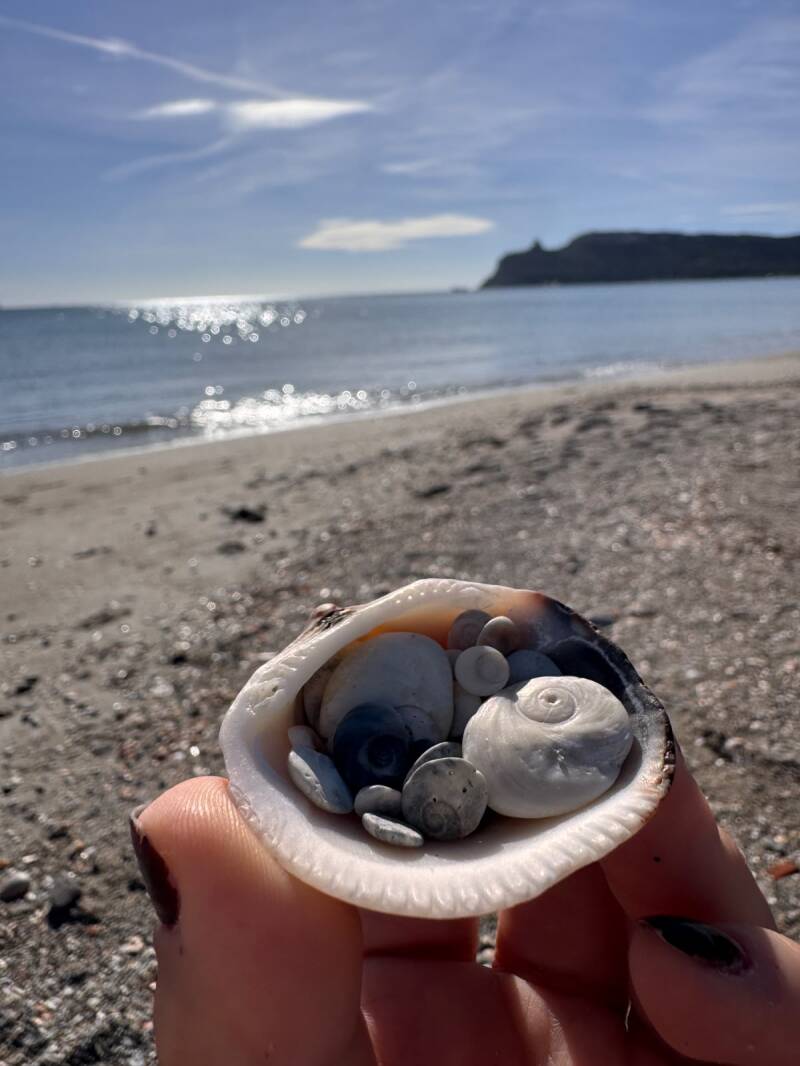
Studying Jung trains the eyes to see, and the ears to listen, for synchronicities: those moments when an inner question finds its answer outside. And mine arrived on a chilled Saturday morning by the sea.
On what should be an ordinary Saturday (or is it a privilege to call it ordinary?) my friend and I were walking along the shore when we noticed the sand was covered in shells. Almost at once, we both caught ourselves wishing we hadn't chosen a walk for that morning, as if the plan we'd made an hour earlier had become a law. It's curious how the mind can keep us inside a square we have already outgrown. So I cut it. I suggested we stop walking and sit, and look for the shells instead. If that was what the morning was calling for.
My friend said that, if she were choosing shells for herself, she wouldn't take the ones that had been little homes, meaning the ones that once sheltered a living creature, and could become home for another in the future. We agreed on that. But quietly, I wanted exactly those. The little homes were the ones that intrigued me most.
And then we found them: tiny houses no longer lived in, fossils now, closer to stone than to shell, with their whole history drawn on the surface. A small spiral, polished by time. Each turn, the record of a season of growth.
The creature that built it never demolished its home in order to grow. It simply added to it.... a little at a time, each new chamber built from the edge of the last. As it grew, the house grew with it, keeping the same shape at every age. What lived inside was what the house had been built around.
The psyche grows in the same format. It moves in a spiral, meaning we return to the same places (the same fears, the same longings, the same themes) again and again. But never from the same point. Each return happens one layer up, a turn wider, seen from a little higher. What we learned in the last cycle becomes the lens through which we look at that place the next time we pass by it. Revisiting is not regressing; it is circling the center from further out.
Time is what turns the spiral. What we feed it is what it becomes.
Our way of relating to the world is imprinted in the first lines. The earliest experiences that formed the base of the shell. Every turn that follows rises from that first curve, and we cannot redraw it, left only the decision of choosing what inhabits the house as it grows as an act of consciousness. That part of the work is ours.
The poet Louise Glück, in a poem fittingly titled Nostos (homecoming, in Greek), suggests that we truly see the world only once, as children, and that everything after is memory. Perhaps that is why the old places keep calling back. Not to trap, but to offer a different dose: the same theme, met now with more capacity, more distance, finding meaning. What was once poison, revisited at another turn, may become medicine.
We grow by circling slowly around the center, each turn bringing us a little nearer to who we are. As individuals and community. To those curious enough to notice, this leaves a quiet responsibility: to inhabit the house we build, and to tend to what we let live inside it.
And maybe that is the right dose of change. Enough to grow. Not so much that we forget whose home this is.
Add comment
Comments